Arguments are a normal part of life. They happen at school between classmates, at home with family, and even among close friends. One person says something, the other hears it differently, and before long, things blow up. For many, the default response is to either shut down or fight back. But there’s another way.
Mediation offers a practical, human approach to sorting things out before they spiral. It gives people the tools to stay calm, speak up, and actually listen, not just wait for their turn to talk. It’s not about winning an argument. It’s about understanding what’s going on and finding a way forward that works for everyone.
What Is Mediation, Really?
Mediation is a process where people in conflict are supported to talk things through with the help of someone trained to guide the conversation. But more than that, it’s a mindset. It’s about slowing things down, listening without interrupting, and being open to seeing the situation from someone else’s point of view.
There’s no shouting, blaming, or being told what to do. Mediation isn’t there to decide who’s right or wrong. It creates space for people to work out their own answers, with support, not pressure. And while it’s used in workplaces and schools, it’s just as useful in daily life.
Knowing how mediation helps with conflict means being able to respond, not react. It’s the difference between a conversation that ends in slammed doors and one that ends in understanding.
Real People, Real Change
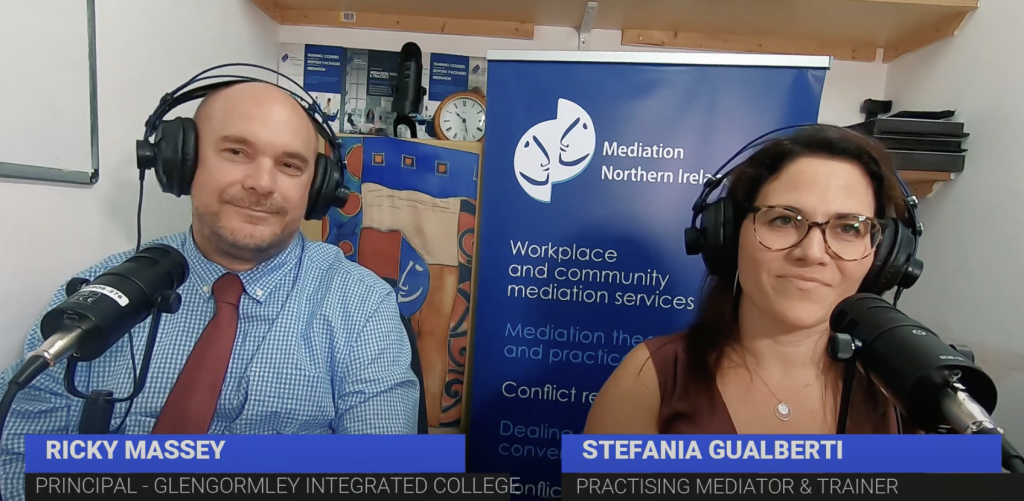
Two people who really show how mediation works are Stefania – one of our Associates as well as a Trainer – and Ricky; Head of Glengormley Integrated College and a recent graduate of both our Mediation Theory & Practice and Principled Negotiation open access courses.
Stefania discovered mediation through her Peace Studies course and has been working in the field ever since. What drew her in was the idea that people can actually find their own answers, given the right support. She now delivers mediation training and sees again and again how it helps people deal with real-life situations, both personal and professional.
Ricky’s journey started in a completely different place. He came across mediation while working in a role where he often had to calm down frustrated customers. Without realising it, he was already using many of the same skills: listening properly, managing emotions, and helping people feel heard. Training with Mediation Northern Ireland helped him recognise what he was doing, sharpen his approach, and start supporting others in a more structured way.
Both Stefania and Ricky highlight how mediation helps with conflict not only in official settings but also in everyday moments. It changes how people approach tension; with more patience, more listening, and less stress.
In Episode 7 of our podcast, The Resolution Room, Ricky and Stefania offer a rich and timely conversation on how mediation skills are making a difference in classrooms, staff rooms, and beyond.
From Tension to Talking
It doesn’t take much for things to boil over; especially in fast-paced environments like schools, busy homes, or shared workspaces. What mediation offers is a simple but powerful shift: instead of reacting in the heat of the moment, it encourages people to pause, reflect, and respond with care.
Creating that pause changes everything. It helps people focus less on the argument itself and more on what’s underneath it. Often, conflict transcends the issue on the surface; it’s about feeling unheard, misunderstood, or disrespected. Mediation helps uncover that.
When people feel safe to speak and know they’ll be listened to without being judged or shut down, the whole dynamic changes. Instead of shouting matches or silent treatment, people start to open up. They explain how they feel, what they need, and what could make things better. This is where resolution happens… through understanding.
And that’s something that anyone can learn. Mediation is for anyone who wants to handle conflict better and build stronger relationships.
Everyday Benefits of Mediation
Understanding how mediation helps with conflict means recognising its impact across different areas of life. Some of the everyday benefits include:
- Stronger Relationships – People learn to communicate better, reducing arguments and building trust.
- Better Communication Skills – Mediation teaches active listening, clear speaking, and respectful disagreement.
- More Confidence – Knowing how to handle difficult conversations gives people confidence in school, at work, and at home.
- Less Stress – When conflict is handled calmly and openly, it creates a more peaceful environment for everyone.
- Problem Solving Skills – Mediation focuses on finding practical solutions that everyone can agree on.
Start Learning Mediation Skills Today
If you’re interested in learning how mediation helps with conflict, Mediation Northern Ireland offers a wide range of training courses that suit every level. Whether you’re new to the idea or looking to build on what you already know, there’s a course that fits.
Training is available in different formats:
- Open-access courses – perfect for individuals or small groups who want to join others and learn together.
- Tailored training for groups – if you already have a group in mind, we can deliver the course just for you, shaped around your priorities and schedule.
- Flexible delivery – training can be adapted to fit your timescales, and additional learning support is available if needed.
- Independent accreditation – available for most courses, offering recognition for your learning.
These aren’t just one-off sessions. They’re designed to build long-term skills in communication, conflict management, and understanding. Whether you’re a team leader, teacher, youth worker, or just someone who wants fewer arguments and better conversations, mediation training offers tools that last a lifetime.
👉 Explore our course options today and take the first step towards calmer, stronger conversations.